The low/slow/small gap
A few thousand dollars of hobby airframe can destroy a tank. It can close an airport, or put a hole in a refinery that takes months to repair. It flies low, it is small, and most air defence was built to catch something else entirely.
That is a physics problem before it is an engineering one. Radar wants a target that is high, fast and metal. A plastic airframe with a few motors reflects almost nothing, and what little comes back arrives from down in the ground clutter, mixed in with hedges and rooftops and traffic. Radars also reject low-velocity returns on purpose, so a drone creeping in near the ground falls into the same blind spot that stops every lorry on the bypass from registering as a contact. Radar is also expensive, and it broadcasts its own position the whole time it runs, which also turns the sensor itself into a target worth destroying.
Then the costs invert. The drone costs hundreds to a few thousand dollars. The missile you would shoot it down with costs millions, and the tank it just killed cost millions more. Anyone can afford to send them, nobody can afford to intercept all of them.
None of which is only a wartime problem, or only a problem for those with an air defence budget.
UK drone sightings around prisons rose 770% between 2019 and 2023, and in June 2026 the government committed £35 million to counter-drone measures at 17 high-risk sites, alongside steel grilles for 13,000 cell windows. In the United States the same problem runs as an organised supply chain. In June 2026 the US Justice Department charged 12 people over an operation that ran six drones into 10 federal prisons across eight states, at least 38 times between September 2023 and May 2026, flying in drugs, blades and phones from a former daycare in Macon, Georgia. Inmates used smuggled phones to guide the pilots in. The line from the indictment worth keeping is this one: authorities found some, but not all, of the drops.
Between 20 and 26 November 2024, around 170 drone sightings were logged over RAF Lakenheath, RAF Mildenhall and RAF Feltwell, three bases used by the USAF, in swarms of up to 20 at a time. Lakenheath is not an ordinary base: analysts at the Federation of American Scientists assess that it has been prepared to store US B61 nuclear bombs again, which would be the first on British soil since 2008. A Ministry of Defence Police inquiry identified no suspects, and no verified footage has ever surfaced publicly. The IISS later concluded the drones were most likely launched from Russian-linked commercial ships sitting in the North Sea. A police helicopter sent up to look had a near miss with an F-15.
So the list of places that need to know a drone is overhead keeps growing: prisons, airbases, refineries, data centres, ports, stadiums, and any vessel that would rather not find out the hard way. Some are fixed, some move, all need to be defended against drones.
The conventional sensors each have their own blind spot. RF detection loses the drone the moment it stops transmitting, which a growing share of them do by design. Cameras have to see it first, which after dark or in bad weather means thermal imaging, and thermal good enough at range is both expensive and, in the capable versions, export-restricted. Each is a real tool, and each costs real money per site.
The option that caught my eye was the least sophisticated on the list. A microphone costs almost nothing, has nothing to aim or steer, and a drone is not quiet. Put several of them in an array and the small differences in when the sound reaches each one give you a bearing to the source, so the same cheap part that hears the drone can also point at it.
The idea is not mine. A wave of defence startups is betting on exactly this. 9 Mothers, a Y Combinator-backed team, sells a passive acoustic sensor called Vor built on the same premise, that a drone gives itself away through the air long before anything can see it. Vor listens for the propulsion signature, works out a rough bearing, and hands the track to whatever does the shooting. That part is usually a different company's hardware: Allen Control Systems' Bullfrog, for one, is an autonomous machine-gun turret that slews onto a cued bearing and engages from there. A cheap ear pointing an expensive gun.
Ukraine has already proved the cheap end works. Their acoustic network, Sky Fortress, runs on roughly 9,500 sensors according to The War Zone's reporting from July 2024, at somewhere around $400 to $500 a node. The microphones do not shoot anything down. They cue mobile fire teams who do. Defense One reported one raid in which 80 of 84 incoming drones were brought down, and made the comparison that sticks: the whole network cost less than a pair of Patriot interceptors, at roughly $4 million each.
Why sound at all
A microphone emits nothing, so there is no signal to detect and nothing for an anti-radiation weapon to home on. It is entirely passive, sitting there and listening. It is also cheap. A microphone and a small computer is the whole bill of materials, which is what makes a network of 9,500 of them affordable in the first place.
There is also a physical guarantee under all of this. A drone stays airborne by spinning propellers fast enough to push its own weight of air downward, and shifting that much air makes noise whether the designer wants it to or not. The sound is not a quirk of any particular model. It is a by-product of flight. You can chip away at it, and some designers have tried, with quieter blade shapes and shrouded rotors, but quiet is hard won and you cannot switch the noise off without landing.
Sound diffracts, so it does not need line of sight. It bends over the hedge and around the building. A camera has to see the drone; a microphone only needs the air between you to be connected.
This also covers the drones that give an RF sensor nothing to work with. A drone flying a pre-loaded waypoint route is not transmitting anything. A fibre-optic-guided drone runs its control link down a physical spool of glass. Both are invisible to RF detection, which needs the drone to be shouting, and neither of them is any quieter for it.
Where sound fits
Acoustic is a layer, not an answer. Its range is short: hundreds of metres at the very best, per node, not kilometres. Anyone selling you sound as a perimeter is selling you a perimeter you can walk through.
The weaknesses are the interesting bit, though. Acoustic fails on range, wind and ambient noise. Radar fails on clutter and small cross-sections. RF fails on silence. EO/IR fails on fog and darkness. Those failure modes barely overlap, and non-overlapping weakness matrices are the reason layered systems exist. Sound is not good enough on its own. It fails in different places from everything else, which is what makes it worth adding.
| modality | range vs small drones | low/slow/small | RF-silent drones | weather sensitivity | unit cost |
|---|---|---|---|---|---|
| radar | long | weak: low RCS, ground clutter, slow targets filtered | detects, no emissions needed | moderate: rain and clutter degrade it | high |
| RF detection | long, while the drone emits | fine if the link is active | blind: nothing to detect | low | low to moderate |
| EO / IR | moderate, cueing helps; line of sight only | hard: small visual and thermal target | detects | high: fog, rain, cloud, night (EO) | moderate to high |
| acoustic | short to very short: tens to low hundreds of metres per node | good: propulsion noise is the signature | detects, hearing the propellers rather than the comms | moderate to high: wind noise, ambient masking | very low, about $400 to $500 per node in Sky Fortress reporting |
The honest cell is the one that carries the table: acoustic's range. The modality comparison follows Dong et al., "Securing the Skies" (CVPR 2025 Anti-UAV Workshop). The only hard cost figure here is Sky Fortress's, from the reporting linked above.
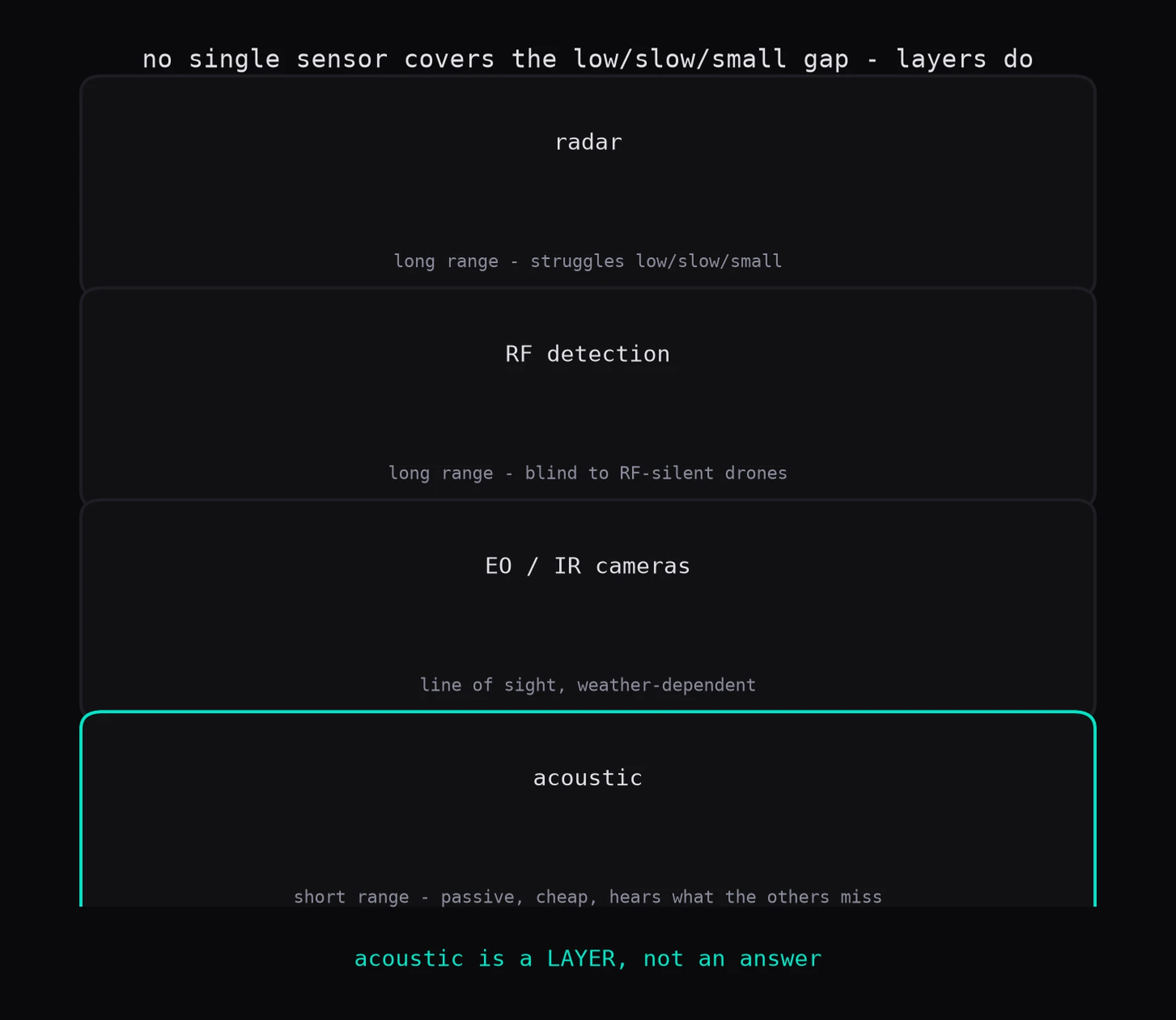
Acoustic is a layer, not an answer. Figures regenerate from scripts/blog_figures.py.
What a drone sounds like to a machine
A propeller is a periodic noise machine. Each blade passing a fixed point makes a pressure pulse, so the rate is blade count times revolutions per second, which for small multirotors puts the fundamental somewhere in the low hundreds of hertz. The pulse train is periodic but it is not a pure sine, so you do not get one tone. You get a stack: the fundamental, plus harmonics at integer multiples marching up the spectrum.
On a spectrogram that is unmistakable. Horizontal lines, evenly spaced, sustained for as long as the motors are turning. It looks like a comb.
The confusables sort themselves out nicely against that. Wind is a broadband smear with no structure. Birdsong is impulsive and vertical, chirps that sweep across frequency in a fraction of a second, which is the opposite geometry. Neither looks anything like a comb.
Then there is rotating machinery, which stacks harmonics for the same physical reason. A washing machine on its spin cycle does much the same thing.
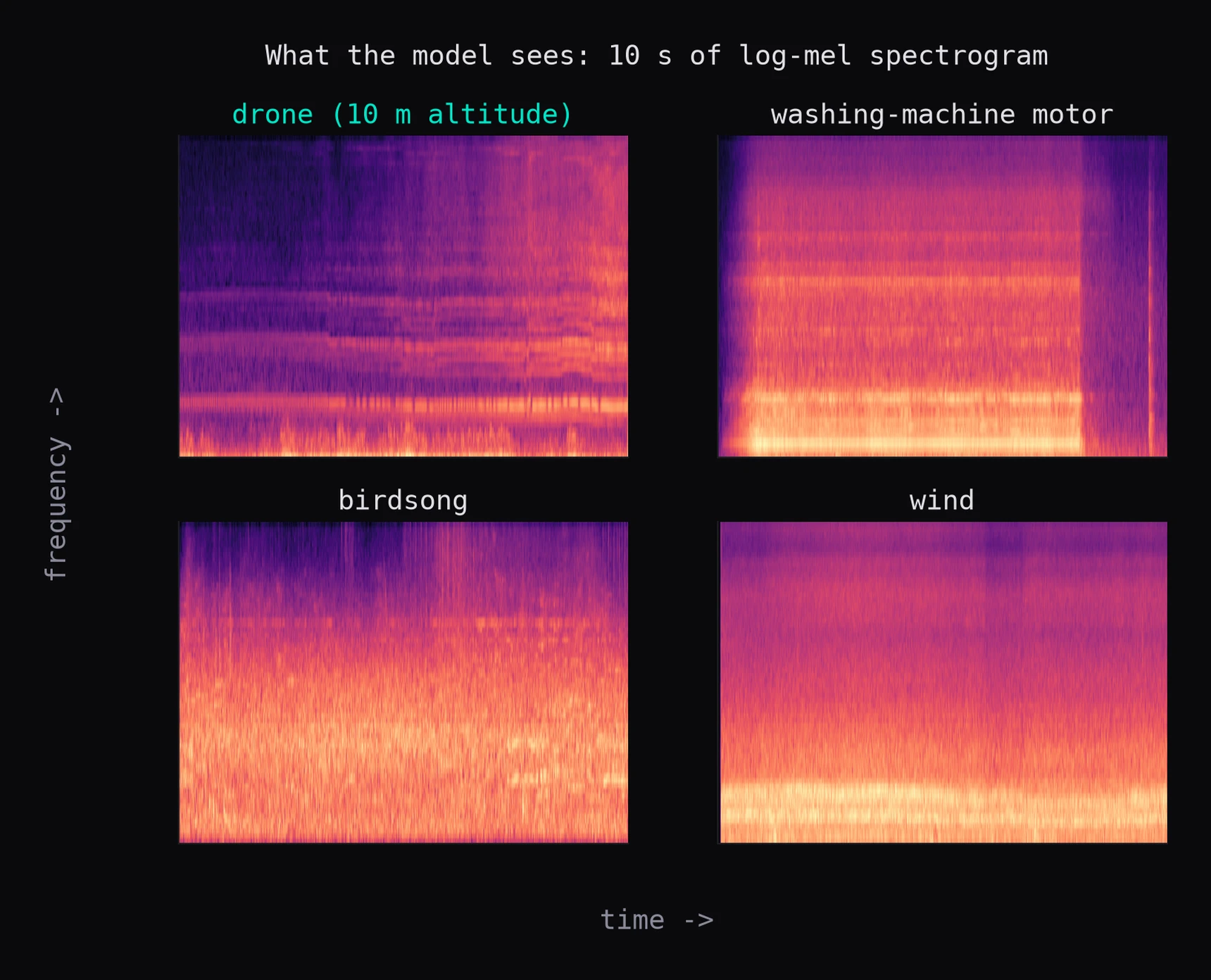
Four sounds, ten seconds each: a drone at 10 m (DroneNoise dataset, University of Salford, CC BY 4.0), a washing machine ("washing machine" by ptrflr, Freesound #397622, CC BY 4.0), birdsong ("pidgeons city park" by pawsound, Freesound #154866, CC0 1.0) and wind ("Strong wind" by lextrack, Freesound #344887, CC0 1.0). The washing machine is in here deliberately, because rotating machinery stacks harmonics too. Figures regenerate from scripts/blog_figures.py.
I put the washing machine panel in that figure on purpose, and I would ask you to look at it for longer than feels necessary. Cover the titles and tell me which one is the drone. If two sounds produce spectrograms that look that similar, no amount of clever architecture is going to save you. The problem was never whether a network can see harmonic stacks. It is whether it can tell which harmonic stack is flying, which is Part 2's subject, and which is a data problem rather than a modelling one.
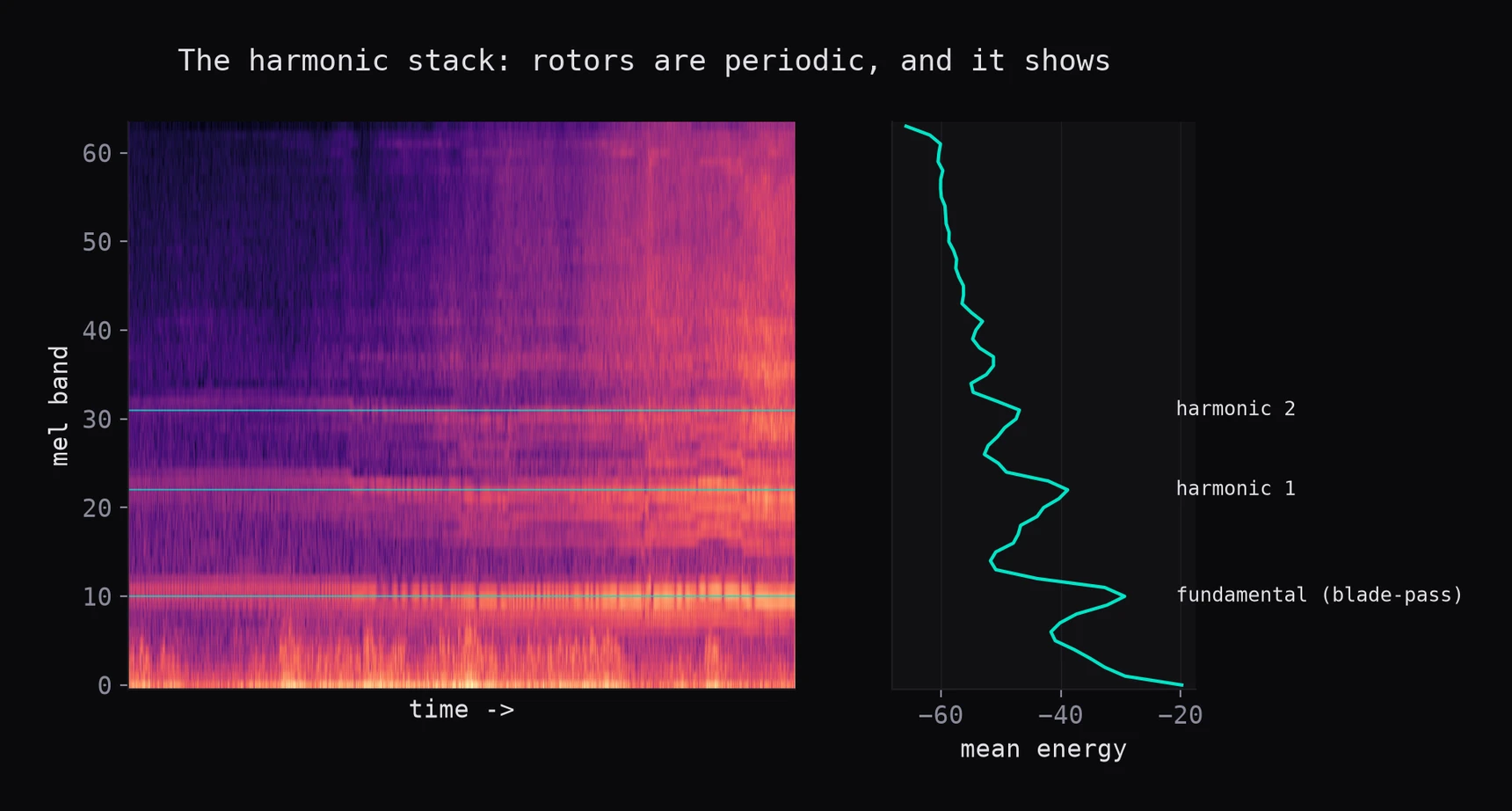
The blade-pass fundamental and two harmonics, picked out automatically. Same DroneNoise clip as the drone panel above, CC BY 4.0. Figures regenerate from scripts/blog_figures.py.
Air absorbs high frequencies far more aggressively than low ones, and the effect compounds with distance. That is the standard atmospheric absorption model, ISO 9613-1, and it is not controversial.
Follow it through, though, and it is genuinely nasty. As the drone gets further away the top of the harmonic stack dies first, and the structure erodes downwards. What reaches the microphone at range is a dull hum with the distinguishing detail sanded off, and the distinguishing detail is exactly what the model keys on. So the drone does not fade evenly into the noise. The part that identifies it goes first.
That mechanism is behind a curve in Part 3 that I found quite hard to look at.
What comes next
So far this has all been the case for listening. Whether it actually works is a separate question, and it is the one the rest of the series tries to answer.
Part 2 is the negative set: everything in the world that is not a drone. It turned out to matter more than the drone half, and the public datasets that are supposed to help are less independent, and more contaminated, than they look. The washing machine was not a rhetorical device.
Part 3 is the evaluation, done as honestly as I could manage. A threshold fixed before I looked at the results, tested on drones the model had never heard, recorded through other people's microphones. To keep it from firing at every passing noise, the detector only alarms after a sustained run of drone-like seconds, nine of them in these first experiments. Across six hours of drone-free audio, its worst near-miss reached seven of those nine. Two windows, about a second, between silence and a false alarm.
Part 4 is contact with reality: my hardware, my garden, my problem. When the parts arrive.
